

Consumer Credit Market Size, Share & Forecast 2026–2035, Expanding at a 5.05% CAGR
Consumer Credit Market
Consumer Credit Market Size, Share and Research Report By Payment Method (Cash, Card-Based, Digital Payments, Others), By Credit Type (Revolving Credit)
The Consumer Credit Market is expanding as digital lending platforms, flexible financing options, and growing consumer spending continue to drive credit demand worldwide”
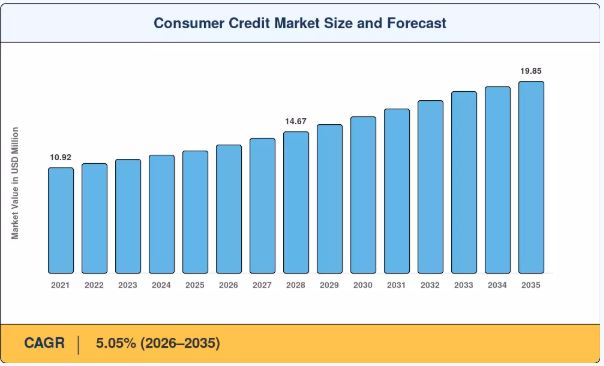
NEW YORK,, NY, UNITED STATES, June 22, 2026 /EINPresswire.com/ -- The Global Consumer Credit market closed 2025 at USD 12.65 billion and is projected to grow from USD 13.29 billion in 2026 to USD 19.85 billion by 2035, registering a compound annual growth rate (CAGR) of 5.05% during the forecast period. Consumer credit encompassing personal loans, credit cards, auto loans, home equity loans, student loans, and the fast-expanding buy now pay later (BNPL) category is the financial infrastructure that enables household consumption, asset acquisition, and economic participation across every income tier globally. — Market Research Future (MRFR)
Two forces anchor this market’s trajectory: the global rollout of real-time payment rails including the US FedNow service that surpassed 1,400 participating institutions in 2025 and sustained venture investment into embedded lending infrastructure, with global fintech lending platforms attracting upward of USD 21 billion in equity and debt facilities during 2024 alone.
Technology is fundamentally rewriting how consumer credit reaches the household. Branch-centric underwriting desks and paper-based credit scorecards are giving way to API-based underwriting engines that ingest cash-flow data, payroll feeds, open banking transaction records, and alternative behavioral signals in seconds.
Machine-learning risk models trained on non-traditional data including telecom utility records, payroll histories, and everyday transaction patterns are extending credit access to thin-file and previously unscorable consumers, expanding the addressable market well beyond traditional cardholders while improving default-rate forecasting for financial institutions. Policymakers tightening disclosure standards around revolving credit have, somewhat counterintuitively, accelerated formalization of the sector by pushing informal lending into regulated digital channels.
Get Full PDF Sample Copy of Report: (Including Full TOC, List of Tables & Figures, Chart) @
https://www.marketresearchfuture.com/sample_request/41113
➤How Significant Is the Consumer Credit Market’s Growth?
The consumer credit market has demonstrated resilient and sustained expansion despite a challenging macroeconomic backdrop of elevated benchmark interest rates and rising household debt saturation in mature markets. Growing from USD 12.65 billion in 2025 to a projected USD 19.85 billion by 2035, the market’s 5.05% CAGR reflects the structural durability of consumer credit demand across economic cycles and the powerful expansion of addressable borrower populations through digital and embedded lending channels.
Credit cards retained market leadership with a 42.6% payment method share in 2025, anchored by entrenched issuer relationships, rewards ecosystems, and the durability of revolving credit balance behavior. Revolving credit products as a whole held a 49.9% share of the consumer credit market in 2025, underscoring the sustained role of card-based balances as the primary consumer debt financing vehicle across North America and Europe.
Buy now pay later credit platforms are the market’s fastest-growing segment, projected to expand at a 9.85% CAGR through 2035, as checkout-embedded financing scales across retail, travel, and healthcare verticals. Fintech-originated installment loans are tracking an 8.32% CAGR the fastest among all credit-type segments — driven by their superior underwriting speed, mobile-first origination experience, and ability to serve borrowers underserved by traditional credit card lending infrastructure.
➤ What Does the Future Hold for the Consumer Credit Market?
Embedded credit in non-financial platforms represents the market’s most expansive near-term opportunity. Marketplaces, ride-hailing applications, SaaS billing platforms, and healthcare patient portals are becoming primary consumer credit distribution channels, embedding personal loan and BNPL credit products directly within the consumer journeys where purchase intent is highest. This distribution model lowers customer acquisition costs dramatically while surfacing proprietary underwriting data unavailable to traditional lenders, enabling fintech credit infrastructure providers to compete effectively against incumbent card issuers with structurally lower cost-to-serve models.
Open banking mandates are progressively unlocking the data infrastructure underpinning next-generation consumer credit underwriting. The EU’s PSD2 framework has given underwriters direct cash-flow visibility for over 12 million linked accounts, enabling dynamic risk pricing that improves credit access for consumers with variable income profiles while reducing adverse selection losses for lenders.
India’s account aggregator framework, live since 2021, has enabled consent-based financial data sharing underpinning millions of small-ticket personal loan credit products for borrowers previously outside the formal credit system. Similar open banking frameworks advancing in Brazil, the UK, Australia, and Singapore are creating new credit access infrastructure across the world’s largest emerging consumer credit markets.
Alternative-data credit scoring is expanding the global consumer credit market’s addressable borrower base toward its theoretical maximum. Machine-learning models incorporating payroll data, telecom and utility payment histories, rental payment records, and behavioral transaction signals are enabling financial institutions to safely extend credit access to the estimated 1.4 billion adults globally who remain credit-invisible under traditional bureau-based scoring methodologies.
Regulators and international development finance institutions including the IFC have signaled strong support for validated alternative-data scoring as a tool for financial inclusion, creating a supportive policy environment for lenders adopting these approaches across emerging market consumer credit portfolios.
➤ Who Are the Key Players in the Consumer Credit Market?
The consumer credit market is served by a diverse competitive landscape spanning global banking institutions with deep consumer lending franchises, specialized credit card issuers, and a rapidly scaling cohort of fintech-native embedded lending platforms. MRFR identifies the following key participants shaping the market:
★JPMorgan Chase & Co. — the largest US bank by assets and a dominant consumer credit issuer, offering a comprehensive portfolio of credit card lending, personal loans, home equity products, and auto financing through the Chase brand, with industry-leading rewards programs and digital origination capabilities
★Citigroup Inc. — a global consumer banking and credit card leader, operating one of the world’s largest branded credit card portfolios across North America, Asia-Pacific, and Latin America, with strong presence in co-branded travel and retail card programs.
★Capital One Financial Corporation — a technology-forward consumer credit issuer distinguished by its data-driven underwriting methodology, mass-market and subprime credit card lending expertise, and significant digital banking and auto lending operations.
★Synchrony Financial — the largest provider of private-label credit card lending in the United States, partnering with major retailers, healthcare providers, and automotive dealers to offer point-of-purchase financing and co-branded credit card products at scale.
★American Express Company — a premium consumer and small business credit card issuer commanding the highest average spend per cardholder in the industry, with a differentiated rewards ecosystem, travel benefits platform, and charge card model that maintains full-balance monthly repayment requirements.
★Affirm Holdings, Inc. — a leading US buy now pay later credit platform partnering with over 300,000 merchants to offer transparent, no-late-fee installment loan products at checkout, with a differentiated model that does not charge revolving interest and targets credit-conscious millennial and Gen Z borrowers.
★Klarna Bank AB — the world’s most widely used BNPL credit platform globally, offering four-installment, pay-in-30-day, and longer-term financing products integrated into the checkout flows of over 500,000 merchant partners across 45 countries, with a growing financial services and shopping app ecosystem.
★PayPal Holdings, Inc. (incl. Pay Later) — a global digital payments and consumer credit platform offering Pay Later BNPL products and PayPal Credit revolving lines embedded within its two-sided merchant and consumer payments network, leveraging proprietary transaction data for real-time underwriting at checkout.
The competitive landscape is being reshaped by the convergence of payments and credit infrastructure, with traditional card issuers investing in BNPL and embedded lending capabilities while fintech credit platforms build deposit and banking products that increase customer lifetime value and reduce funding cost. Strategic partnerships between credit platforms and non-financial distribution channels are emerging as the defining go-to-market strategy for the next growth phase.
➤ What Are the Emerging Trends in the Consumer Credit Market?
Several transformational trends are redefining the consumer credit market’s evolution through 2035:
Embedded BNPL at Checkout Normalization: Buy now pay later credit has transitioned from a niche checkout button to default retail financing infrastructure. US BNPL originations exceeded USD 100 billion in gross merchandise value during 2024, and major payment processors have integrated installment options natively within their merchant checkout flows.
The convenience of point-of-sale credit approval is pulling first-time borrowers into retail consumer financing channels at unprecedented scale, particularly among younger demographics who prefer installment structures over revolving card balances.
API-Based Real-Time Underwriting: Lenders replacing batch credit decisioning with real-time API underwriting have compressed approval times from days to seconds, enabling new consumer credit product formats including earned wage access, micro-lending, and instant personal loan credit products that match the speed expectations of mobile-first borrowers. The adoption of open banking data feeds and payroll APIs is enabling dynamic, cash-flow-based credit pricing that benefits both prime and near-prime consumer segments.
Smartphone-First Credit Access in Emerging Markets: In Asia-Pacific, embedded credit is reaching new borrower populations through digital wallets rather than traditional bank branches. India’s account aggregator framework, China’s super-app credit ecosystems, and Southeast Asia’s mobile lending platforms are collectively onboarding hundreds of millions of first-time borrowers into formal consumer credit markets, driving the region’s exceptional 11.25% CAGR the highest of any region in the global consumer credit market.
Data Monetization & Underwriting-as-a-Service: Credit infrastructure platforms are unbundling the underwriting stack into modular API services — credit scoring engines, fraud detection, identity verification, and risk-based pricing that non-financial platforms can embed within their own user journeys. This underwriting-as-a-service model is enabling retailers, gig economy platforms, and healthcare providers to offer branded consumer credit products without building proprietary lending infrastructure.
Algorithmic Fairness & Regulatory Scrutiny of AI Credit Models: As machine-learning models assume greater underwriting authority, regulators across the US, EU, and UK are intensifying scrutiny of AI credit scoring systems for evidence of discriminatory outcomes across protected demographic characteristics. Lenders investing in explainable AI underwriting architectures and bias-testing frameworks are building the regulatory compliance capabilities necessary to sustain alternative-data scoring at scale through the evolving supervisory environment.
BNPL Regulation & Consumer Protection Expansion: Regulators increasingly treat buy now pay later credit as a credit product subject to affordability assessment, disclosure, and billing-dispute obligations equivalent to traditional lending. The US CFPB’s 2024 interpretive rule extending billing-dispute protections to BNPL accounts, and similar EU Consumer Credit Directive updates, are raising compliance costs and shaping the competitive dynamics of the embedded lending market through 2035.
Get access to the full description of the report @
https://www.marketresearchfuture.com/reports/consumer-credit-market-41113
➤ How Is the Consumer Credit Market Segmented?
The consumer credit market report provides a comprehensive segmentation framework:
By Credit Type: Personal Loans, Home Equity Loans, Credit Cards, Auto Loans, Student Loans
By Borrower Profile: Individuals, Small Business Owners, Students, Homeowners, Low-Income Borrowers
By Repayment Structure: Fixed Rate, Variable Rate, Installment Payments, Revolving Credit, Flexible Payments
By Loan Purpose: Debt Consolidation, Home Renovation, Education Expenses, Major Purchases, Emergency Funds
By Financing Source: Traditional Banks, Credit Unions, Online Lenders, Peer-to-Peer Lending Platforms, Finance Companies
By Region: North America, Europe, Asia-Pacific, South America, Middle East & Africa
➤ What Are the Regional Insights from the Consumer Credit Market?
North America dominates the global consumer credit market with a 40.8% share in 2025, anchored by the United States’ deep adoption of credit card lending, mature regulatory frameworks governing consumer debt financing, and the scale of incumbent issuers including JPMorgan Chase, Citigroup, Capital One, and American Express.
Aggregate US household debt surpassed USD 17.9 trillion in 2024, reflecting the centrality of consumer credit to American household financial management. While growth in the US revolving credit segment is constrained by high household leverage, the market’s innovation frontier — BNPL regulation, open banking infrastructure, and embedded lending platforms — is being actively shaped by the US regulatory and venture capital ecosystem.
Europe holds the second-largest regional share, supported by harmonized consumer credit disclosure rules under the EU Consumer Credit Directive, rising demand for personal loan credit products as an alternative to revolving card balances, and the progressive expansion of PSD2 open banking data infrastructure enabling more accurate and inclusive credit underwriting.
The United Kingdom, Germany, France, and the Netherlands are the primary markets, with strong fintech lending platforms including Klarna, Zilch, and Monzo Credit competing alongside incumbent bank consumer lending franchises for digital-native borrower relationships.
Asia-Pacific is the fastest-growing regional market for consumer credit, recording a projected CAGR of 11.25% through 2035 more than double the global average driven by the emergence of smartphone-first credit access models across India, China, Indonesia, the Philippines, and Vietnam.
India’s account aggregator framework and digital public infrastructure are enabling millions of micro-loan and personal loan originations monthly for borrowers without formal credit histories. China’s super-app embedded credit ecosystems operated through Ant Group’s Huabei and JD Finance’s Baitiao platforms have already onboarded hundreds of millions of digital credit users, establishing Asia-Pacific as the most dynamic consumer credit market globally.
South America and the Middle East & Africa represent emerging growth frontiers for consumer credit formalization. Brazil’s PIX instant payment infrastructure and open finance framework are enabling a new generation of fintech lenders to compete with incumbent banks for personal loan and credit card lending market share, while Mexico’s growing embedded lending ecosystem is addressing significant financial inclusion gaps.
Across Sub-Saharan Africa and the Middle East, mobile money platforms and digital wallet-based micro-credit products are providing first formal consumer credit access to populations historically excluded from traditional banking and credit card lending channels, establishing the long-term foundations for a structurally significant consumer credit market expansion.
➤➤➤ Explore Emerging Opportunities with Market Research Future:
Laser Projector Market-
https://www.marketresearchfuture.com/reports/laser-projector-market-8339
Body Area Network Market-
https://www.marketresearchfuture.com/reports/body-area-network-market-8516
Gyroscope Market-
https://www.marketresearchfuture.com/reports/gyroscope-market-8536
Smart Doorbell Market-
https://www.marketresearchfuture.com/reports/smart-doorbell-market-8627
Solid State Relay Market-
https://www.marketresearchfuture.com/reports/solid-state-relay-market-8645
Led Drivers Market-
https://www.marketresearchfuture.com/reports/led-drivers-market-8665
Vcsel Market-
https://www.marketresearchfuture.com/reports/vcsel-market-8672
Ai-Powered Storage Market-
https://www.marketresearchfuture.com/reports/ai-powered-storage-market-8703
Ips Display Market-
https://www.marketresearchfuture.com/reports/ips-display-market-8706
Insuretech Market-
https://www.marketresearchfuture.com/reports/insuretech-market-8745
Sagar Kadam
Market Research Future
+ +1 628-258-0071
email us here
Visit us on social media:
LinkedIn
Facebook
X
Legal Disclaimer:
EIN Presswire provides this news content "as is" without warranty of any kind. We do not accept any responsibility or liability for the accuracy, content, images, videos, licenses, completeness, legality, or reliability of the information contained in this article. If you have any complaints or copyright issues related to this article, kindly contact the author above.
