

Your top news on consumer products
Provided by AGP
Philippines Breakfast Cereals Market 2026-2034 | Size, Share, Price, Trends
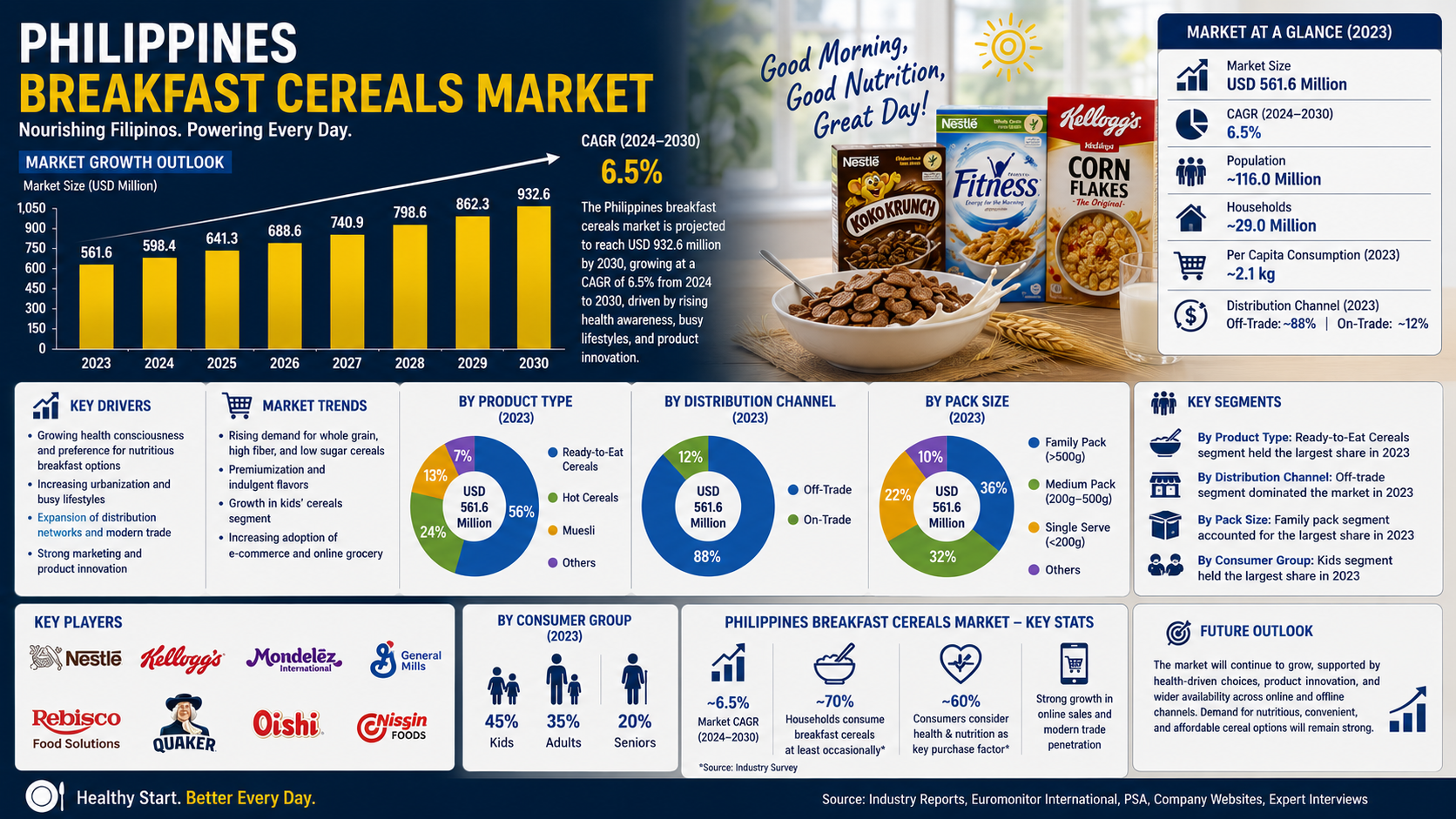
Philippines breakfast cereals market size reached USD 2,251.18 Million 2025 and is projected to reach USD 3,033.52 Million 2034, at a CAGR of 3.37% 2026-2034..
PHILIPPINES, May 19, 2026 /EINPresswire.com/ --Market Overview:
The Philippines breakfast cereals market is experiencing steady expansion, driven by rising health and wellness consciousness among Filipino consumers, the increasing adoption of convenient ready-to-eat breakfast options amid rapid urbanization, and the proliferation of modern retail and e-commerce platforms enhancing product accessibility across the archipelago. The market reached USD 2,251.18 Million in 2025 and is projected to attain USD 3,033.52 Million by 2034, registering a compound annual growth rate (CAGR) of 3.37% during 2026-2034. The expansion is being fueled by growing disposable incomes among the expanding middle-class population, heightened awareness of balanced nutrition driving demand for fortified and whole-grain cereal products, the premiumization trend encouraging investment in organic and functional ingredient offerings, accelerating product innovation with localized Filipino flavors and snack-cereal crossover formats, expanding supermarket and hypermarket networks across urban and suburban areas, and the convergence of digital marketing strategies with online retail channels that are broadening consumer reach across Luzon, Visayas, and Mindanao.
Why is Hot Today Philippines Breakfast Cereals Market?
The Philippines breakfast cereals market is commanding heightened attention as evolving consumer preferences, intensifying competition, and strategic product innovation are reshaping the sector's competitive dynamics. Health-conscious Filipino consumers, particularly urban millennials and Gen Z demographics, are increasingly gravitating toward fortified, whole-grain, and low-sugar cereal products, with more than a third of consumers expressing preference for fiber and multigrain claims. The buy-now-pay-later and subscription-based models on e-commerce platforms are improving cereal accessibility and driving repeat purchases. Major manufacturers are expanding their portfolios with functional ingredients, strawberry-flavored variants, and duo-format cereals targeting younger demographics. Meanwhile, price sensitivity remains a defining factor, with manufacturers balancing premiumization strategies against affordable small-pack formats to penetrate price-conscious suburban and rural markets across the Philippine archipelago.
Philippines Breakfast Cereals Market Summary:
• Ready-to-eat cereals are dominating as the largest type segment, driven by the growing preference for convenient breakfast solutions among time-pressed urban consumers who are seeking nutritious, quick-preparation options that are fitting seamlessly into increasingly busy Filipino lifestyles.
• Conventional cereals are commanding the dominant share by nature, as mass-market cereal brands with established distribution networks are maintaining strong consumer loyalty through competitive pricing, familiar flavors, and widespread availability across supermarkets, convenience stores, and sari-sari shops.
• Supermarkets and hypermarkets are leading the distribution channel segment, as the expansion of modern retail formats across Metro Manila and secondary cities is providing consumers with broad product assortments, promotional displays, and in-store sampling opportunities that are driving cereal purchase decisions.
• Online stores are emerging as the fastest-growing distribution channel, with expanding internet penetration, mobile commerce adoption, and e-commerce platform partnerships enabling cereal brands to reach digitally connected consumers through bundle offers, subscription services, and targeted promotional campaigns.
• Organic breakfast cereals are registering accelerating demand among health-conscious and higher-income consumer segments, as growing awareness of clean-label ingredients, pesticide-free sourcing, and natural sweeteners is driving willingness to pay premium prices for organic cereal products.
• Product innovation in localized flavors and snack-cereal crossover formats is intensifying market competition, with manufacturers introducing Filipino-inspired tropical fruit flavors, small-pack formats for on-the-go consumption, and duo-textured cereals that are expanding consumption occasions beyond traditional breakfast.
• Luzon is commanding the largest regional share of breakfast cereals market revenue, anchored by Metro Manila's high population density, elevated disposable incomes, extensive modern retail infrastructure, and strong consumer exposure to international cereal brands and health-driven marketing campaigns.
Porter's Five Forces Analysis – Philippines Breakfast Cereals Market
The Philippines breakfast cereals market, valued at USD 2,251.18 Million in 2025 and projected to reach USD 3,033.52 Million by 2034 at a CAGR of 3.37% (2026–2034), presents a stable, health-led growth environment. Rising wellness consciousness, urbanization, e-commerce expansion, and growing disposable incomes are steadily lifting demand. The following Porter's Five Forces framework evaluates the market's competitive structure through a positive, opportunity-focused lens.
Bargaining Power of Suppliers – Moderate
The cereal value chain is well-organized and globally integrated, ensuring reliable input flows.
• The Philippines has no commercial production of wheat, oats, barley, or rye, so manufacturers source grains internationally — yet diversified origins (United States, Australia, Canada) and rising regional corn supply keep procurement stable. USDA-FAS Manila notes growing milling-wheat and corn imports through MY 2024/25 in line with strong food demand.
• Large players such as Nestlé Philippines and Pepsi-Cola Products Philippines (Quaker) benefit from global parent-company procurement scale and long-term contracts, which moderates supplier leverage and supports stable pricing.
• A mature local packaging, sugar, and dairy ecosystem further balances supplier power, enabling cost-efficient domestic production and co-manufacturing.
2. Bargaining Power of Buyers – Moderate to High
Filipino consumers are value-conscious and increasingly health-aware, which constructively drives innovation.
• Price sensitivity remains significant, particularly in suburban and rural areas, prompting brands to offer affordable small-pack and sachet formats alongside premium SKUs — broadening accessibility across income levels.
• A strong wellness shift is steering demand toward fortified, whole-grain, high-fiber, and low-sugar cereals, encouraging clean-label and functional innovation.
• Expanding modern retail and e-commerce give buyers wider choice and easy price comparison, rewarding brands that deliver nutrition, convenience, and value together.
3. Threat of New Entrants – Moderate
The market is welcoming to innovators while still rewarding established scale.
• Low capital barriers for niche, organic, or locally flavored cereals (e.g., tropical-fruit blends, native-grain mueslis) allow agile homegrown brands and MSMEs to enter via online channels and specialty stores.
• At the same time, established players enjoy meaningful advantages — strong brand equity (Nestlé's Koko Krunch is the most advertised and most popular cereal brand), national distribution, and shelf-space dominance in supermarkets.
• Regulatory enablement through the Philippine Food Fortification Act and the DOH/FNRI "Sangkap Pinoy" Seal supports credible, nutrition-led market entry.
4. Threat of Substitutes – Moderate to High
Cereals compete with deeply rooted local breakfast traditions, but this also creates whitespace.
• Traditional Filipino breakfasts — sinangag (garlic fried rice), pandesal, champorado, and lugaw — are culturally favored and often cheaper, representing the primary substitution pressure.
• Forward-looking brands are converting this into opportunity by localizing flavors and bridging the snack-cereal crossover, positioning cereals for on-the-go and multi-occasion consumption rather than breakfast alone.
• Premium hot cereals such as Quaker oats are differentiating on documented health benefits (fiber, heart health, weight management), strengthening cereals' value proposition versus alternatives.
5. Competitive Rivalry – Moderate to High (Healthy and Innovation-Driven)
Competition is vibrant and innovation-led rather than purely price-driven.
• The landscape blends multinational leaders — Pepsi-Cola Products Philippines (Quaker, leading on hot cereals), Nestlé Philippines (Koko Krunch, Honey Stars, Milo Cereals, Trix, Fitnesse, Gold Corn Flakes), and Kellogg's — with agile local and private-label brands.
• Differentiation centers constructively on nutrition, fortification, localized flavors, snackable formats, and packaging innovation, supported by dual modern-retail and e-commerce distribution.
• AI adoption — growing at roughly 38% annually in the food industry — is enhancing demand forecasting, quality control, and product development, lifting operational efficiency across competitors.
Strategic Outlook
The Philippines breakfast cereals market offers a steady, health-anchored growth opportunity through 2034. Reliable global sourcing, an aspirational and increasingly wellness-oriented consumer base, an innovation-friendly entry climate, and healthy multi-tier rivalry collectively support sustained value creation. Brands that invest in fortified and whole-grain formulations, locally inspired flavors, affordable value packs, snack-cereal crossovers, and omni-channel distribution — while expanding reach into Visayas and Mindanao alongside the established Luzon base — are best positioned to capture the projected USD 3.03 Billion opportunity.
Request for a sample report PDF: https://www.imarcgroup.com/philippines-breakfast-cereals-market/requestsample
Market Trends and Insights:
• The premiumization of breakfast cereals is accelerating as Filipino consumers are increasingly willing to pay higher prices for products offering whole-grain content, reduced sugar formulations, functional ingredients such as probiotics and added vitamins, and clean-label positioning that are aligning with the growing preventive healthcare mindset.
• The expansion of modern retail formats including supermarkets, hypermarkets, and convenience stores is broadening cereal product visibility and availability, with enhanced shelf space allocation, promotional displays, and in-store sampling campaigns driving trial and repeat purchases across urban and suburban markets.
• E-commerce and mobile commerce platforms are transforming cereal purchasing behavior, with online channels offering bundle deals, subscription services, and doorstep delivery convenience that are particularly appealing to digitally native younger consumers and time-pressed working professionals.
• The snack-cereal crossover trend is expanding consumption occasions beyond traditional breakfast, with manufacturers introducing small-pack formats, portable packaging, and indulgent flavor varieties that are positioning cereals as versatile anytime snacking options for children and young adults.
• Nutritional fortification is becoming a key competitive differentiator, with cereal brands investing in formulations enriched with iron, calcium, B-vitamins, and dietary fiber to appeal to health-conscious parents seeking convenient yet nutritious breakfast solutions for their families.
• Sustainability considerations are gaining importance in consumer purchase decisions, with manufacturers exploring eco-friendly packaging materials, responsible sourcing practices, and waste reduction initiatives that are resonating with environmentally aware Filipino consumers and supporting long-term brand loyalty.
Market Growth Drivers:
Rising Health Consciousness, Nutritional Awareness, and Preventive Healthcare Demand
The Philippines breakfast cereals market is primarily driven by the growing health and wellness consciousness among Filipino consumers who are increasingly prioritizing nutritional value in their daily dietary choices. Rising awareness of chronic lifestyle diseases including diabetes, cardiovascular conditions, and obesity is compelling consumers to seek breakfast options that offer whole-grain content, dietary fiber, reduced sugar, and functional nutritional benefits. Government nutritional awareness campaigns and school-based feeding programs are further reinforcing the importance of balanced breakfast consumption. Urban parents are viewing fortified breakfast cereals as a practical and time-efficient alternative to traditional hot breakfasts, expecting higher nutritional value and convenience from packaged cereal products. This health-driven demand is encouraging manufacturers to invest in ingredient innovation, transparent nutritional labeling, and targeted marketing that resonates with wellness-focused Filipino lifestyles.
Urbanization, Rising Disposable Incomes, and Changing Lifestyle Patterns
Accelerating urbanization and the expansion of the Philippine middle-class population with growing disposable incomes are serving as critical growth catalysts for the breakfast cereals market. The increasing concentration of population in Metro Manila and secondary cities including Cebu, Davao, and Clark is driving demand for convenient, time-saving breakfast solutions that are fitting into increasingly busy urban lifestyles. Dual-income households, longer commute times, and the growing participation of women in the workforce are reducing time available for traditional breakfast preparation, creating sustained demand for ready-to-eat cereal products. Rising purchasing power is enabling consumers to trade up from basic cereal products to premium, organic, and specialty variants, supporting market value growth beyond volume expansion alone.
Retail Modernization, E-Commerce Expansion, and Product Innovation
The rapid modernization of retail infrastructure and the expansion of digital commerce channels across the Philippines are providing critical distribution platforms for breakfast cereal market growth. The proliferation of supermarkets, hypermarkets, and convenience stores in urban and suburban areas is increasing product visibility, enabling promotional activities, and broadening consumer access to diverse cereal brands and formats. The accelerating growth of e-commerce platforms is extending market reach to provincial and rural areas where modern retail penetration remains limited. Manufacturers are driving market competition through continuous product innovation, including localized Filipino flavors, multigrain blends, fortified formulations, duo-textured cereals, and affordable small-pack formats that are catering to diverse consumer preferences and income levels across the archipelago.
Browse the full report with TOC and list of figures: https://www.imarcgroup.com/philippines-breakfast-cereals-market
Market Segmentation:
IMARC Group's research categorizes the Philippines breakfast cereals market as follows:
By Type:
• Ready-to-Eat
• Hot Cereals
By Nature:
• Conventional
• Organic
By Distribution Channel:
• Supermarkets and Hypermarkets
• Specialty Stores
• Online Stores
• Others
By Region:
• Luzon
• Visayas
• Mindanao
Key Players:
The competitive landscape of the Philippines breakfast cereals market is characterized by intense competition among established multinational corporations and regional food conglomerates. Major players operating in the market include Nestle Philippines Inc., Kellogg Company (Kellanova), General Mills Inc., Universal Robina Corporation (URC), PepsiCo Inc. (Quaker Oats), Post Holdings Inc., Monde Nissin Corporation, RFM Corporation, Procter & Gamble Philippines, and San Miguel Food and Beverage Inc., among others. These companies are differentiating through product innovation in health-oriented formulations, localized flavor development, competitive pricing strategies across value and premium tiers, expansion of distribution networks, and targeted digital marketing campaigns to capture evolving consumer preferences across urban, suburban, and rural Philippine markets.
Recent News and Developments:
April 2026: Nestle Philippines announced a price stabilization strategy for its food and beverage portfolio including breakfast cereals, holding the line on consumer prices amid global commodity cost pressures, reinforcing its commitment to product affordability and market share retention across the Philippine archipelago.
January 2025: Universal Robina Corporation expanded its Nutri-Plus fortified snack distribution program to Indonesia, building on its Philippine nutrition-focused portfolio and strengthening its reputation as a health-oriented food manufacturer with expertise in fortified product development.
2025: Nestle Philippines expanded its breakfast cereals portfolio with new flavor variants including strawberry-flavored and duo-format cereal products targeting younger demographics, leveraging its established KOKO KRUNCH and MILO cereal brands to capture growing demand for innovative breakfast options.
2025: The Philippines e-commerce grocery sector registered accelerating growth, with major online platforms expanding cereal product assortments and introducing subscription-based purchasing models that are improving consumer convenience and driving repeat purchase behavior across digitally connected urban markets.
November 2025: Global cereal manufacturers including General Mills and WK Kellogg intensified competition in the breakfast category through product innovation in sugar reduction and whole-grain reformulations across flagship brands, with new functional cereal variants entering Southeast Asian markets including the Philippines.
August 2025: Ateneo de Manila University researchers presented AI-powered solutions for Philippine food businesses at an international conference, demonstrating how artificial intelligence and machine learning technologies are being applied to digitize operations and optimize food retail processes across the Philippine market.
Speak to an analyst for a customized sample report PDF: https://www.imarcgroup.com/request?type=report&id=44469&flag=C
Note: If you require any specific information that is not covered currently within the scope of the report, we will provide the same as a part of the customization.
Other Report by IMARC Group:
Philippines Meat Market 2026: https://www.imarcgroup.com/philippines-meat-market
Philippines Animal Feed Market 2026: https://www.imarcgroup.com/philippines-animal-feed-market
Philippines Pet Food Market 2026: https://www.imarcgroup.com/philippines-pet-food-market
Philippines Protein Bar Market 2026: https://www.imarcgroup.com/philippines-protein-bar-market
Philippines Soup Market 2026: https://www.imarcgroup.com/philippines-soup-market
About Us
IMARC Group is a global management consulting firm that helps the world's most ambitious changemakers to create a lasting impact. The company provides a comprehensive suite of market entry and expansion services. IMARC's offerings include thorough market assessment, feasibility studies, company incorporation assistance, factory setup support, regulatory approvals and licensing navigation, branding, marketing and sales strategies, and partner identification and procurement. From conducting thorough market research to assisting with factory establishment, IMARC Group is the trusted partner for businesses looking to establish a strong presence in international markets.
Contact Us
IMARC Group
134 N 4th St., Brooklyn, NY 11249, USA
Email: sales@imarcgroup.com
Tel. No.: (D) +91 120 433 0800
United States: +1-201-971-6302
Elena Anderson
IMARC Services Private Limited
+1 201-971-6302
email us here
Legal Disclaimer:
EIN Presswire provides this news content "as is" without warranty of any kind. We do not accept any responsibility or liability for the accuracy, content, images, videos, licenses, completeness, legality, or reliability of the information contained in this article. If you have any complaints or copyright issues related to this article, kindly contact the author above.
